

DID YOU KNOW?

Larry Lambourne
Larry Lambourne is a member of the Ottawa chapter for more than 25 years. His hobby is maintain and repair fishing reels.
This article was originally published in the Release Journal of Spring 2025 (Vol.48 Issue 1)
DID YOU KNOW – that it’s a good idea to check the tightness of your reel’s handle nut and the large screw that secures the clutch lever?
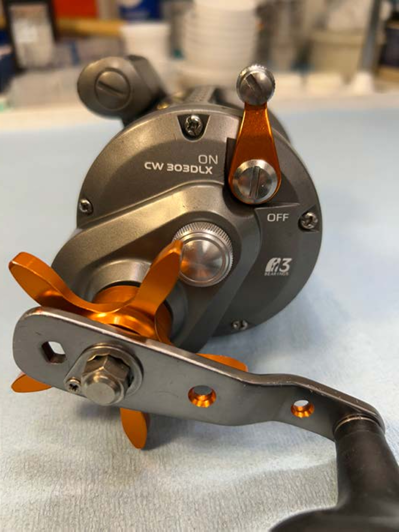
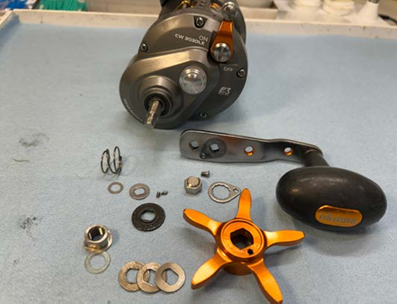
I have found it to be relatively common on Okuma Cold Water reels that the above-mentioned parts work themselves loose over time. The vibration of the reel while trolling causes the handle nut retainer screw and the handle nut to loosen to the point where they will fall off. There is a large spring under the drag star which sends the handle flying, and all the parts retained under it either end up in the bottom of the boat, or in the drink. Unfortunately, the cost to replace all these parts is over $40.
If you find that your handle is a bit wobbly, do not hesitate to tighten it up. As it wiggles, it will round off the keyed edges on the drive shaft and the handle. This goes for any reel. The same applies for the clutch lever screw. It will eventually round out, requiring parts replacement.
There have been a few people who were quite shocked when lifting their rod out of the rod holder only to find everything on the handle side of the reel to be missing.
DID YOU KNOW – that birds’ nests (also known as professional over run for some) or your spool suddenly engaging can be caused by your line being spooled too loosely?
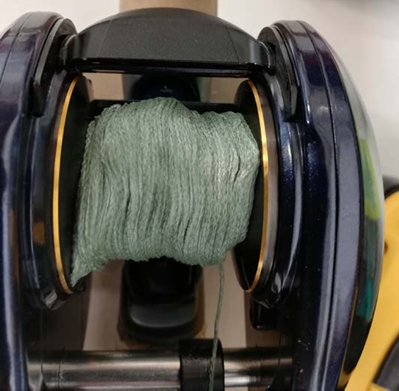
You can be fooled that your line is tight because the line that you continuously cast out and retrieve is under load and will spool evenly and tightly when retrieved. The problem is when you cast, you peel off the tightly packed line and then when you reel in under load, your taut line often cuts into the softer spooled line underneath at the start of the retrieve. That’s why your line snaps or your reel engages seemingly at the same spot each cast, due to the line being embedded deep into the softer line.
Eventually the line on your spool will crush the softer line underneath and interfere with your line spooling. The line on this spool looked perfect at first glance, however when the “fished” portion of line was removed this is how it looked underneath. A good habit to practice is to let a bunch of your line out with a weight or lure on it when idling out in the boat. This will provide sufficient tension to properly spool your new line.
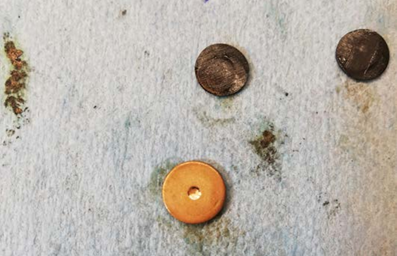
Instead of using the thumb to control the cast, the tendency is to crank the spool cap down so tight that it wears holes through the materials that are in the cap to provide proper spool alignment and movement. These spacers / washers are comprised of many different types of materials: brass, Delrin, fiber, Teflon and so on. I’ve seen where they have been screwed so tight that the drive shaft in the reel has distorted the spool cap. Tightening to these extremes is not necessary and will impede your casting distance.
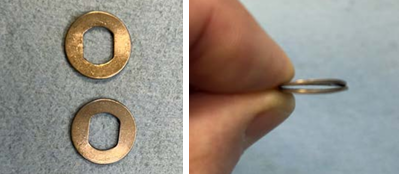
DID YOU KNOW – that leaving your drag cranked down tight can affect your drag setting? The ability to gradually adjust the drag pressure in your reel is supplied by the Belleville washers. These are a metal cupped washer that compresses as you tighten down the star drag assembly.
If your drag is left tightened, two things can occur: the metal washers’ eventually fatigue and they will lose their tensile properties, or your drag washers (e.g. carbon fiber) can become crushed, stuck or sticky, which will affect the performance of your drag. This would manifest itself as the drag slipping continuously, despite not being physically able to tighten your drag setting any further.
My recommendation is to loosen your drag at the end of each fishing day, or at the end of the season at a minimum.
Related Posts