
Trolling for Muskies: To hold, or not to hold?
Chris Nielsen
Chris Nielsen has a B.Sc. in Fisheries and Wildlife Management and is an Environmental Consultant and registered Professional Geoscientist with the Association of Professional Geoscientists of Ontario. He is a long time member of Muskies Canada. He served as Mississauga chapter chairman and Muskies Canada chairman from 2017 to 2019. He's now part of Muskies Canada's Science Committee.
This article was originally published in the Release Journal of Summer 2020 (Vol.43 Issue 2)
Truth be told, I’m a caster. I know – what is a caster doing writing about trolling for muskies. Well, I’m not getting any younger and casting big baits with fast retrieves isn’t as easy as it used to be. And I love catching muskies, and to do that effectively, sometimes trolling is the best approach.
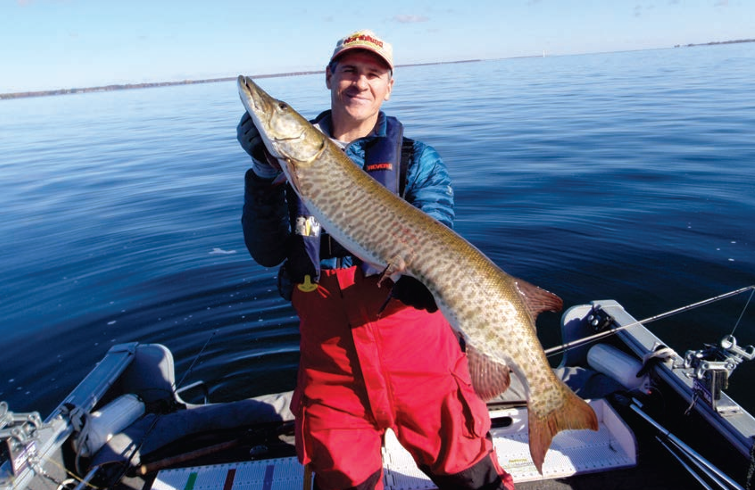
I started thinking about this trolling thing a bit more last year after having a bit of success with it. I didn’t spend very much of my time on the water trolling and still managed to put 4 muskies in the boat. Of particular note is that I had the rod in my hand on each of those four instances, having been working the rod immediately prior to the fish hitting the lure. This seemed to be more than a coincidence so I started giving the subject some thought. It seems to me that holding the rod while trolling simply puts more fish in the boat!
I didn’t come to this realization quickly or intentionally. It happened through a series of unique situations. Two of the fish came while trolling with fishing partners that prefer to troll under some circumstances. One of Larry Lambourne’s regular fishing partners was out of action for a while and I was happy to fill the empty seat. Larry is a very experienced, and very good, troller and I really enjoyed spending a couple of days trolling with him and asking him lots of questions. He is also an excellent net man! Another fish came when I was forced to troll after my electric motor failed. The fourth musky came while paddling a canoe. Editor’s note: Paddling and row trolling are highly effective for many species of fish!
Background
I’ve done a lot of fishing over the years for a wide variety of fish. I have had the pleasure and the honour of sharing time on the water with some people who were very good at what they did, including some very experienced and skilled trollers. I’ve also read way too much about musky fishing and have talked to some of the people I have heard were good trollers and asked them about what they did differently, and why.
This is how it started. I was fishing with Matt Clay at the 2019 Gananoque, Ontario Muskies Canada (MCI) outing and after some long trolling runs on a sprawling expanse of the St. Lawrence River, I picked up my rod and started working it pretty aggressively. Matt looked back and commented something about the good old “Reynolds rip”. Of course, I had no idea what he was talking about and stared at him blankly. He went on to tell me a story about Greg Reynolds who was renowned amongst the local Ontario musky fishing community for holding his rod and working it aggressively, or picking up a rod from the holder and giving it a good rip, dropback and the odd twitch, apparently, with a high degree of success. I made a mental note to talk to Greg to learn more about his methods.
Pulling the Trigger to Catch More Muskies
In any type of fishing, there are two key phases of the process. First you need to attract a fish which can be done through visible cues (color, size, shape, speed), noise and vibrations. Once you have a musky’s attention, you need to trigger them to strike. Anyone who has had numerous follows without a strike, or used a camera while trolling to see how many fish take interest in a bait but won’t commit, knows this can be the hard part. While you are trolling, you need to be incorporating trigging moves at regular intervals to maximize efficiency and capitalize on any fish that are attracted to your bait. There are a number of ways to trigger strikes through boat control.
Trolling in an “S” pattern is a common method to vary the speed and action of lures while trolling. When you turn, the inside line slows down and the outside line speeds up which varies the action of the lure. The same effect can be had when making “L” turns on or around key structural elements such as shoals and bars. Controlling boat speed using the throttle can also introduce erratic, inconsistent behavior to lures that can trigger strikes. Another popular triggering method is to bounce your lure off of structure, usually the bottom, to give the lure an erratic action that often triggers strikes.
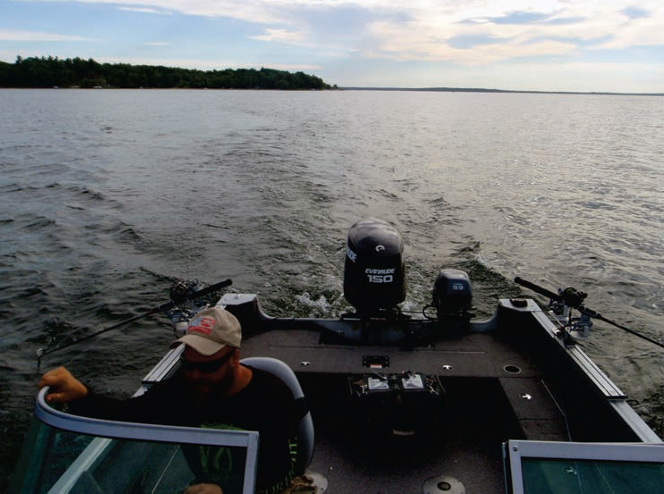
These methods can be very effective but what if I told you there was a better way or at least another way with less chance of snagging your favourite lure on the Canadian Shield. Why not incorporate triggering action by manipulating the rod with a series of pulls, dropbacks and pause twitch manoeuvres? I suggest that they are just as effective, if not more so, with much less risk of wasted time and lost lures due to snags. According to Greg Reynolds, this can increase your success by as much as 3 to 1 versus a rod sitting in the rod holder for the average troller. An added bonus is that when a musky strikes, you can get an appropriate hook set and ensure that the fish is well pinned and take the best approach to ensuring that the hooks are not ripped out by too much pressure.
Manipulating the rod with a series of pulls, dropbacks and pause twitch manoeuvres... can increase your success by as much as 3 to 1 versus a rod sitting in the rod holder
The Mechanics
Holding a rod and manipulating a bait effectively can be physically challenging and require some strategy to reduce fatigue. It is a bit more difficult to hold a rod when you are driving a boat, or at least one equipped with a console and steering wheel. One way to reduce fatigue is to have a rod holder placed far enough forward that the driver can place the rod in the holder frequently to take breaks and rest their arm and shoulder. This challenge is also minimized if you have a tiller drive rig. However, passengers in the boat are free to concentrate on working their baits and triggering strikes. This may even keep them awake during a long day on the water, a challenge that some of my boat partners, as well as myself, have struggled with at times after a long night of telling musky stories. To keep things fair, consider switching up driver and passengers to allow the driver some time to focus on the lures and to rest their arm and shoulder. Don’t do this if your passenger doesn’t know how to drive a boat or doesn’t have their watercraft operator permit. Alternatively, to increase the overall effectiveness of the trolling pass, the driver may want to focus on boat control while leaving lure manipulations to the passengers. This is particularly important when working structural elements versus open water trolling. If the driver’s side rod holder is far enough forward, the driver can pick up the rod periodically to give it a rip and then place it back in the rod holder as a triggering move. A short line out on the driver’s rod will also ensure that bait closely follows the contours or weed edge being tracked to compensate for the lack of attention and action on that rod. Every little bit helps, and as we all know, attention to detail can make the difference between success and failure in musky fishing.
I have observed several MCI members with creative methods for obtaining similar results. Michele Frechette often rigs up a roller/pulley and cord mechanism, similar to the one used to pull downrigger cables and balls close to the boat, to give the bait quick, forward pulls and a subsequent dropback. Bill Van Voorden uses a leather glove to pull the line by hand while the rod is in the holder. Feel free to be creative as any triggering mechanism that makes the lure behave differently or erratically can be effective.
Where and When to Troll
One of the many advantages of trolling is being able to cover lots of water at a precise depth, be it shallow or deep. I suspect that trolling can be effective at any time of the year and in most situations with appropriate modifications to meet the current conditions. I’ve had good success running double 10 spinners 2 metres behind a planer board so they could run right along a shoreline or over heavy, shallow cover. A spinnerbait on a short line under a planer board can be very effective under these conditions if weeks or wood are present. If you are holding the rod, you can control the precise path of the planer board and lure so it is in the optimum location. While holding the rod and not using planer boards, you can make quick adjustments to the lure’s running depth by reeling in line or letting more line out, and by holding your rod tip up high or putting the tip down in the water.
Trolling open water with lures on a short line behind a planer board will keep the lures shallow and away from the boat so as not to spook highriding muskies. Trolling Shadzillas on short lines behind planer boards on waters were ciscoes or whitefish raise to the surface to feed, particularly in the evening and overnight, can be very effective. Although trolling can work anywhere and any time, I would tend to spend more time trolling where fish are scattered and suspended or at depths where casting presentations are less efficient and/or effective.
Typical trolling baits can be very effective while holding the rod, as well as some baits that aren’t normally trolled. Baits like big rubber (Bulldawgs and Medusas) and jerkbaits like Bobbies can be fished a bit slower and get a bit deeper than usual while baits like Suick Thrillers or Sledges can be fished quite quickly. Greg told me that he once won an MCI outing by trolling a Suick at 7 miles per hour. Don’t be afraid to experiment – watch your lures on a short line to see how they react to different movements. Another approach to consider is taking a trolling pass over good structure after you have casted it. Perhaps try a deeper lure or make a pass farther out away from the shallows. The fish may be a bit deeper than you expected or may have followed your bait out away from the shallows and lingered a bit deeper after they moved. Working the bait aggressively with rod in hand can further increase the probability of a strike during the trolling pass. And always work the lure back to the boat when you are done with a trolling run, incorporating some triggering manoeuvres as you retrieve your lure. You may be surprised at how many times this can pay off with a fish given the short amount of time you spend doing it. So, even if you are primarily a caster, like me, consider incorporating some trolling into your musky fishing routine and hold your rod in order to increase your odds of triggering a strike. There’s a good chance it will put a few extra fish in the boat for you this season, particularly if you give your bait a good rip now and then.
Related Posts