
DID YOU KNOW?
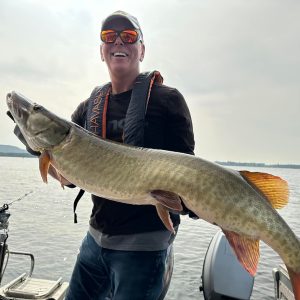
Larry Lambourne
Larry Lambourne is a member of the Ottawa chapter for more than 25 years. His hobby is maintain and repair fishing reels.
This article was originally published in the Release Journal of Winter 2024 (Vol.47 Issue 4)
DID YOU KNOW – That each adult cormorant can eat up to 1 pound of fish per day, consuming approximately 169 pounds of fish per season while they are here (April – October.) A 2007 study showed cormorants in the Kingston area eat a pound of fish per day, while the total population of breeding cormorants in the Kingston area consume approximately 9000 – 18000 pounds of fish per day.
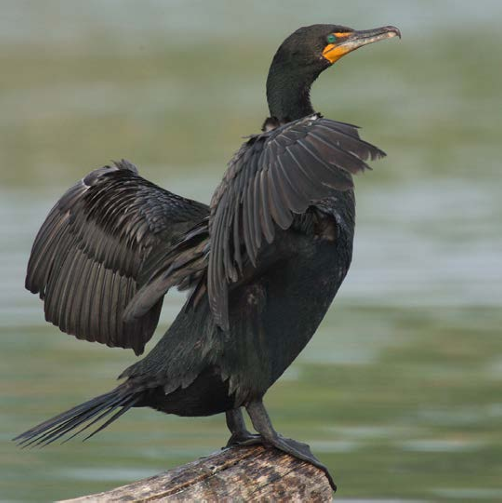
Other water birds consume large amounts of fish, too. In 2012 on Lake Erie, it was estimated that red-breasted mergansers ate 7000 tons worth, cormorants ate 5900 tons, herring gulls ate 1600 tons, and common merganser ate 1100 tons of f ish. (Dr. Chip Weseloh – Wildlife biologist, Canadian Wildlife Service)
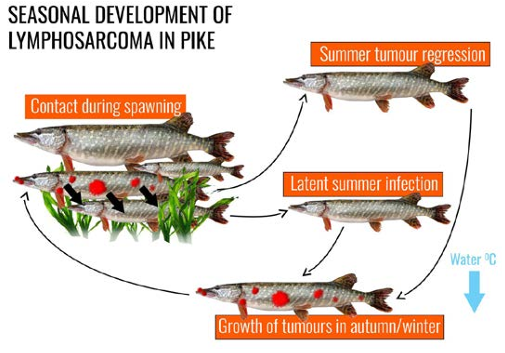
DID YOU KNOW – Lymphosarcoma is a viral disease affecting muskellunge and northern pike. This virus is transmitted during spawning, but the lesions caused by it can vary depending on the season and stage of the disease. In the spring, affected fish have thick white patches on their skin from which viruses are shed, and these in turn infect other fish. Later in the year these patches may heal, forming blotchy red sores, or even normal skin. The virus causing lymphosarcoma infects the white blood cells of the fish and can spread throughout the body during the summer or over several years. This disease can kill infected fish.
DID YOU KNOW – Viral hemorrhagic septicemia (VHS) is an infectious disease found in both fresh and salt water fish species. Outbreaks can occur anytime, but mainly take place during the spring when the temperatures fluctuate and fish are reproducing. In 2005, the introduction of invasive gobies to the Great Lakes system brought VHS to the St. Lawrence River, leading to a three-year long die-off of older, larger female muskies. The population has not fully recovered, and researchers are finding fewer juvenile muskies in the river’s spawning grounds. The virus has now been found in more than 25 species of fish in the Great Lakes.
Viral hemorrhagic septicemia does not affect humans, and fish carrying the virus are safe to handle and eat. As a precaution, avoid fish that appear to be sick or are dead, or dying when caught. The Ministry of Natural Resources recommends various methods of slowing the spread of VHS, including using locally harvested bait, and refraining from moving fish from one location to another. (2013/2014 Guide to Eating Ontario Sportfish.)
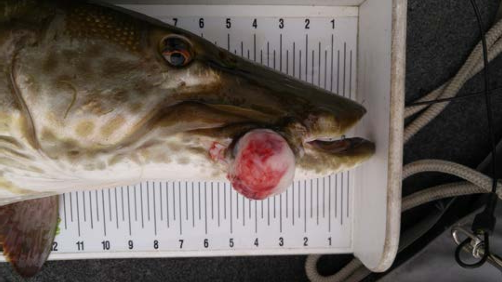
DID YOU KNOW – Occasionally, anglers catch fish with external growths, tumors, sores or other lesions. Such abnormalities generally result from viral or bacterial infections. Growths on game fish caused by viruses include lymphocystis, dermal sarcoma and lymphosarcoma.
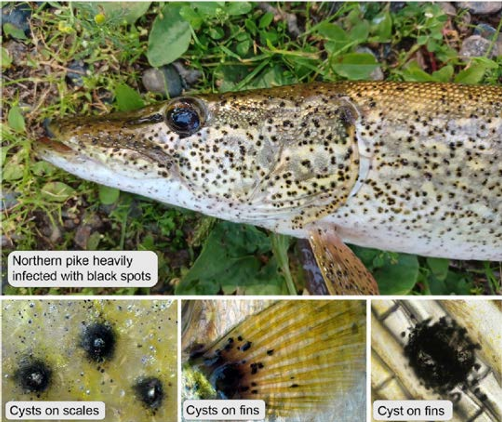
DID YOU KNOW – Black spot is one of the most frequently observed parasites in fish. It appears as small black spots or cysts in the skin, fins and flesh of fish. In the black spot life cycle, fish-eating birds such as herons and kingfishers eat an infected fish. The larval stage, which is inside the black cyst, develops into an adult inside the digestive system of the bird.
Once the parasite has matured, they lay eggs which end up passing into the water column within the bird’s droppings, where they hatch and infect another host, typically snails. Eventually they leave the snail host and burrow through the skin of fish and form cysts, which the fish surrounds with black pigment. This organism does little harm to the fish, but does give the fish an unsightly appearance. Infected fish can be consumed with proper cooking.
DID YOU KNOW – Fish Management Zone (FMZ) 12 is the Ottawa river. It is recognized as the second largest river in eastern Canada, and extends 1271 km (790 miles) from Lake Timiskaming to its outlet into the St. Lawrence River near Montreal. There are 10 reaches of the Ottawa River that are separated by dams / hydroelectric generating stations, or by natural rapids / constrictions.
- Lake Timiskaming
- Lac la Cave
- Holden Lake
- Upper Allumette Lake
- Lower Allumette Lake
- Lac Coulonge
- Lac du Rocher Fendu
- Lac des Chats (Cheneaux GS to Chats Falls / Fitzroy GS)
- Lac Deschenes (Fitzroy to Chaudiere Falls)
- Lac Dollard des Ormeaux (Chaudiere Falls to Carillon GS)
- Lac des Deux-Montagnes
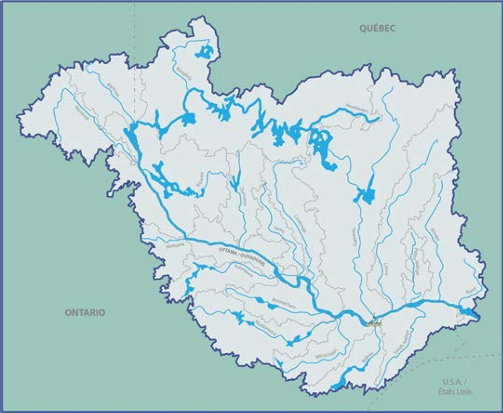
85 fish species are documented overall within FMZ 12. Lac Dollard des Ormeaux (Chaudiere GS at Hull to Carillon GS) is 113 km long, and holds 75 species. Cold, cool and warm water species are present, with simple fish communities in the north, and complex fish communities in the south.
Related Posts