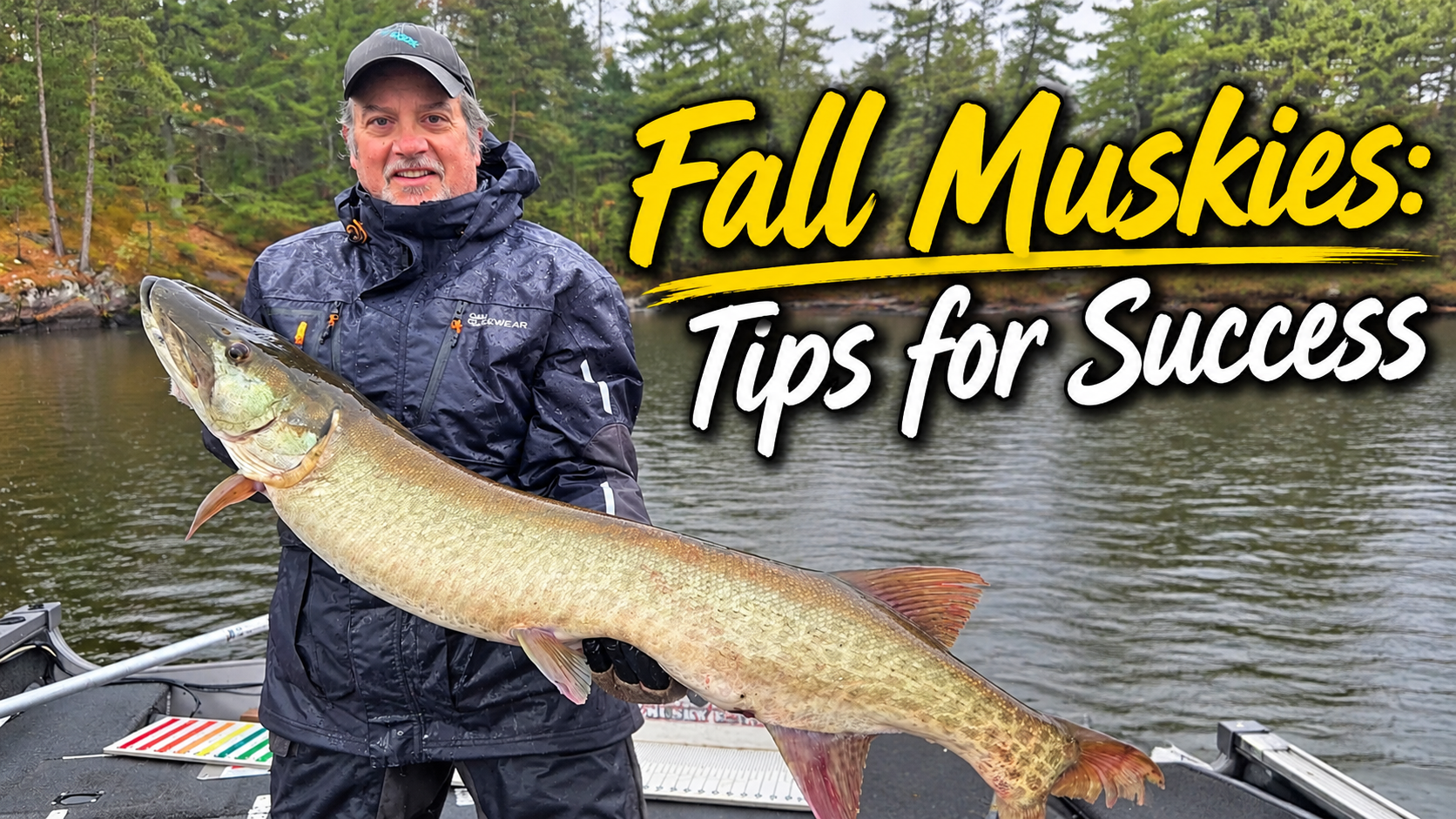
Fall Muskies: Tips for Success
Brent Bochek
Brent Bochek is a renowned fishing guide and an accomplished speaker with more than 200 seminars to his credit. A passionate ambassador for youth fishing, he has been a member of Muskies Canada since 1990 and currently serves as the organization’s National Vice-President. In 2025, he received the Jim Herod Award in recognition of his outstanding contributions to awareness and education.
For a muskie fisherman, fall is a special time of year. The days get shorter, the leaves begin to change, and there’s a crispness in the morning air.
It’s considered big fish season.
Although muskies feed throughout the year, this is the time when they reach their heaviest weights. For females, this is partly due to egg production.
But here’s something to think about: one reason anglers catch big fish in the fall is that muskies become more accessible, not necessarily because they’re feeding more aggressively.
Understanding Fall Muskie Movements
I often hear people talk about muskies putting on the feed bag in the fall, but nothing could be further from the truth. Yes, muskies do feed in the fall, but not as much as they do during the warmer-water period.
Being cold-blooded, a muskie will actually feed more aggressively when the water is warm. They’ll also feed more frequently because the food they eat digests much faster.
This is when casting fast-moving baits such as blades and spinnerbaits can trigger strikes, as well as speed-trolling body baits.
On large bodies of water where seasonal migrations occur, a greater number of larger fish become accessible in the fall as they move into key areas.
Let’s use Lake Erie as an example.
In the fall, large fish congregate in areas such as Buffalo Harbor and the Niagara River, following baitfish and moving closer to their spawning grounds. These are areas where they become much more accessible to anglers.
During the summer months, these same fish can be scattered throughout the lake, following baitfish and making them much harder to target consistently.
The same scenario can be found in Georgian Bay and the St. Lawrence River.
Lake St. Clair is another prime example. During the summer, muskies cruise the lake following baitfish. In the fall, they follow their forage into a few key locations, creating large concentrations of fish in those areas.
Knowing where these fish become more accessible is a key factor this time of year.
Slow Down Your Presentation
Keeping in mind that muskies are cold-blooded, slower-moving baits will generally be more productive this time of year. Baits that have some hang time or can be retrieved slowly can be top producers.
Three baits that will get plenty of use in my boat during the fall are big plastic swimbaits, such as a Curly Sue, a Savage Gear Burbot Tube, and a 14-inch Frankensuick.
These baits have produced quality fish for me over the years.
One thing that plays a huge role when casting jerkbaits in the fall is that you can work them very effectively at slower speeds, particularly dive-and-rise jerkbaits.
You can pull them more slowly and, if weighted properly, give them a longer pause than you would in the spring or summer.
Remember, this is fall, and high-speed retrieves are not part of the game plan. A slow pull and longer hang time allow a muskie to hone in on your presentation without having to exert a lot of energy. You want to give the fish a chance to eat your bait.
During the summer, you can’t retrieve a bait too fast. Muskies are hungry and active, and they’re not shy about chasing down a meal. A high-speed retrieve can be one of the key triggers that gets them to react.
Fishing the Curly Sue
There are two ways I like to retrieve the Curly Sue.
The first is a straight retrieve at a constant speed. That speed will depend on the water temperature. As the water gets colder, I slow down my retrieve. This method works particularly well as the season progresses and temperatures drop.
Let the tail do its magic, and be ready to set the hook at any sign of resistance.
When working these baits slowly, a muskie doesn’t always crash into the bait with a hard strike. Hooksets are free, so be ready to swing hard at any resistance.
Another way I work the Curly Sue is very similar to fishing a jerkbait. The difference is that after you pull the bait, it makes a nose dive instead of rising or remaining at a neutral position like a jerkbait.
Quite often, a strike will come after you stop your pull, while the bait is making its nose dive. But be prepared at any time!
Working the Savage Gear Burbot Tube
The Burbot Tube can also be worked in a number of ways.
During warmer-water periods, a sharp pull followed by reeling up the slack before your next pull can produce strikes from aggressively feeding fish.
Once the temperatures drop, a slower, smoother, more methodical presentation keeps the bait in the strike zone longer. This is especially effective for less aggressive and more lethargic fish.
The 14-Inch Frankensuick: A Fall Favourite
Anyone who knows me knows I love throwing jerkbaits, Suick Thrillers in particular.
A few years back, when the Suick Lure Company introduced the 14-inch Frankensuick, it was a match made in heaven.
Not only does it have the same dive-and-rise action as the Thriller, but it also comes with a weight kit.
This allows you to add different weights depending on how you want to fish it, while also allowing you to fish deeper and slower.
The more weight you add, the longer the bait will hang during the pause. This can be especially helpful during a cold front when fish may be less active.
Even though we’re working these baits more slowly, I still prefer a reel with a high-speed retrieve to pick up slack line.
An Abu Garcia Revo Toro Beast with a 6.2:1 gear ratio, combined with an 8’6″ fast-action, extra-heavy Veritas rod, makes a great setup for throwing these big baits.
It has plenty of backbone, yet just enough give in the tip to allow for a smooth sweep and transition into picking up the slack line.
Personally, I’m not a huge fan of really long rods, and the 8’6″ still allows me to perform a quality boatside maneuver while providing plenty of leverage to cast these big baits.
Be Ready on Every Cast!
In closing, fall can be a magical time of year.
On average, don’t expect to catch as many fish as you might during the summer. But be ready on every cast, because you just never know when you’ll be Setting the Hook!
Related Posts