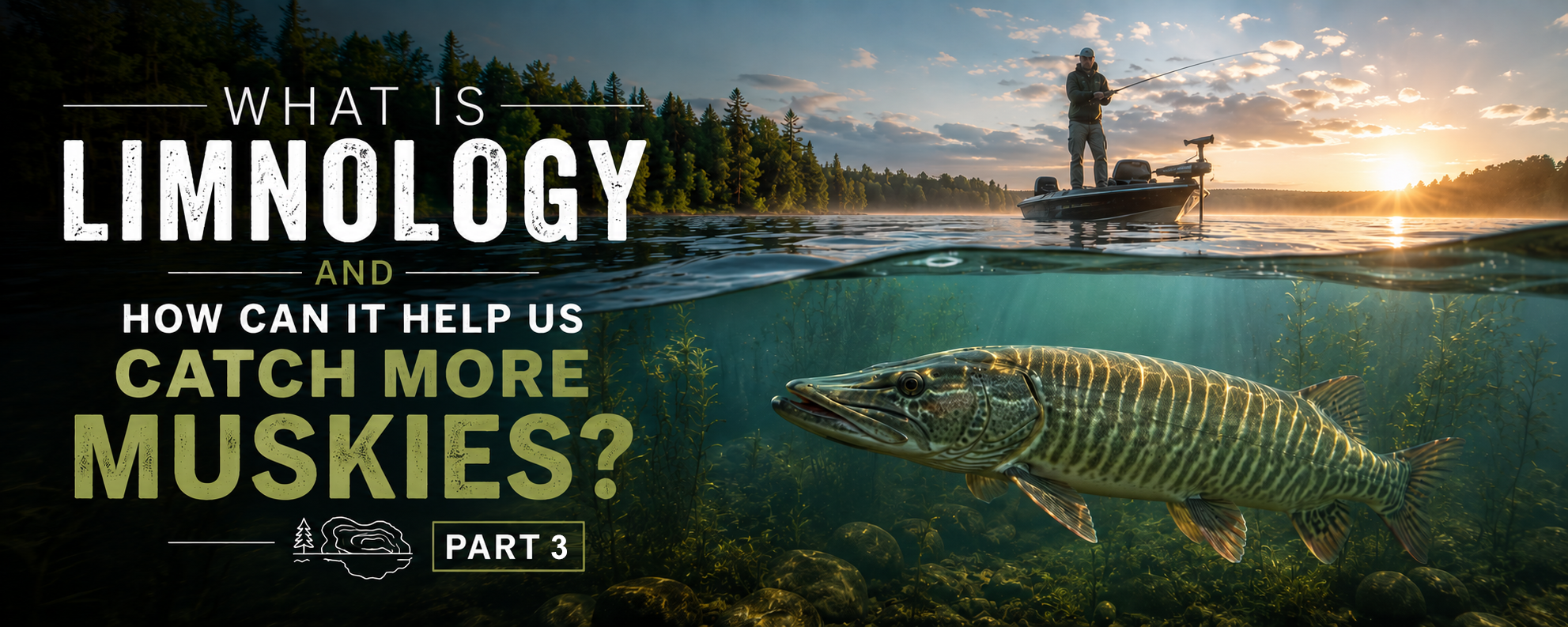
What is Limnology and How Can it Help Us Catch More Muskies? (Part 3)
Chris Nielsen
Chris Nielsen has a B.Sc. in Fisheries and Wildlife Management and is an Environmental Consultant and registered Professional Geoscientist with the Association of Professional Geoscientists of Ontario. He is a long time member of Muskies Canada. He served as Mississauga chapter chairman and Muskies Canada chairman from 2017 to 2019. He's now part of Muskies Canada's Science Committee.
This article was originally published in the Release Journal of Fall 2017 (Vol.40 Issue 3)
We’ve discussed water temperature and thermal stratification and water movement in Parts 1 and 2 of this series. In part 3 we’ll talk about nutrient levels and how they factor into better understanding the body of water you’re fishing.
Part 3 - Nutrient Levels
Nutrient levels in a body of water are a key indicator of the productivity of the ecosystem and a significant factor in determining the types of aquatic organisms present. Understanding the nutrient levels of a water body will provide key information regarding the types and quantities of fish species present as well as other parts of the food web. This can be valuable when trying to determine which lake to fish and when on the water and trying to determine which baitfish species to imitate with your lures.
Water bodies are classified based on their primary productivity, or how much biomass can be generated. This is directly related to nutrient levels. The more nutrients available, the greater the total amount of biological organisms (insect, plants and fish), that can be sustained. Think of the nutrients in a water body as the base of the food chain. The higher the amount of nutrient present, the more plankton, the more weeds, and ultimately, the more fish that the lake can support. In other words, lakes with low levels of nutrients do not produce as many fish per acre as lakes with higher levels of nutrients. The lake classification is something to consider when planning a trip to a new body of water as it can be a determining factor in the type and quantity of fish present as well as the water clarity and the degree to which weeds will come into play with respect to musky location and fishing techniques.
The food chain in a typical lake starts with nutrients that enter the lake from the surrounding air, land and incoming streams. The lowest level in the food chain is phytoplankton (small plants) that require sunlight for photosynthesis and contribute to the nutrient load in a water body. Most of the sunlight is available within the top several metres of the surface and this is where most of the primary productivity or photosynthesis by phytoplankton takes place. Zooplankton (small animals) feed on the phytoplankton and will also be found in similar layers although they may migrate up and down in the water column for protection, going deeper during the day and rising up at night to feed on phytoplankton. Baitfish often follow this migration, and in turn, predatory fish often follow a similar pattern. If you fish in the evening, you may have observed this phenomenon on your sonar with lots of “life” appearing as darkness descends.
Lakes are commonly classified into three categories: oligotrophic, mesotrophic and eutrophic. We’ll describe these each in detail shortly. The process of a newly formed body of water gaining nutrients and evolving from simply a rock pond of water into a thriving ecosystem and eventually into a marsh or wetland is called eutrophication. Although this occurs naturally, human activities have increased the rate of this process in many areas due to phosphates in detergents, fertilizers and the leeching of nutrients from septic systems. This can actually increase the amount of fish present in the short term, but may have a significant detrimental effect on a body of water in the long-term.
When a new lake is formed by a glacier scouring out a hole in the rock and soil and then filling with water as the glacier recedes, this body of water would be classified as oligotrophic. It has very few nutrients and can sustain very little biological life. The water is typically very clear. An example of an Oligotrophic lake would be Lake Superior. As inflowing streams and the air carry dust, soil particles, leaves, and other materials into the lake, the nutrient levels increase and biological organisms, such as phytoplankton, insects and small plants start to grow. This type of water body typically supports insects and invertebrates, some limited plant growth, and cold water fish such as trout or whitefish.
Ove hundreds or thousands of years, the nutrient levels in the water body increase, and sediments build up on the bottom. More organisms and plants can now survive and the biological community evolves as living organisms become more numerous. Growth of aquatic vegetation is concentrated in the littoral zone, or the area along the shoreline, where the most nutrients are present and light penetration drives photosynthesis. This area acts as a nursery for many species of fish and aquatic life such as baitfish and insects are usually abundant in this zone. Cool-water species of fish like pike and smallmouth bass may now be present. This intermediate stage is classified as mesotrophic. Typical examples of mesotrophic lakes would include most of the Kawarth lakes, such as Stoney Lake.
As nutrient levels continue to increase and sediments continue to build up, waters tend to warm and different biological organisms move in. Warm-water fish like muskies and largemouth bass are more common and the total amount of fish present increases. A water body with high nutrient levels, lots of sediments on the bottom, extensive weed growth and lots of fish would be classified as eutrophic. Water clarity in a eutrophic lake is typically reduced due to the high levels of nutrients which fosters growth of phytoplankton and zooplankton. There may also be significant turbidity due to suspended soil particles from the nutrient-rich lands surrounding the lake and sediment in the benthic zone, or lake bottom area including the sediments and water just above it, which can be stirred up during windy conditions. Examples of eutrophic bodies of water could include Lake Scugog and sections of the lower Ottawa River.
Typically, the more nutrients in a water system, the more total biomass of life that will be present and typically the more muskies that will be there. In large bodies of water such as the Great Lakes that would typically be considered oligotrophic or mesotrophic, there may be bays or sections that would be considered more mesotrophic or even eutrophic. There may be some very big muskies in oligotrophic waters, but muskies tend to be less common there than in oligotrophic or eutrophic waters.
Typically, the more nutrients in a water system, the more total biomass of life that will be present and typically the more muskies that will be there.
Typically, the more nutrients in a water system, the more total biomass of life that will be present and typically the more muskies that will be there. In large bodies of water such as the Great Lakes that would typically be considered oligotrophic or mesotrophic, there may be bays or sections that would be considered more mesotrophic or even eutrophic. There may be some very big muskies in oligotrophic waters, but muskies tend to be less common there than in oligotrophic or eutrophic waters.
Aquatic vegetation and lake bottom composition and physical form are often key factors in determining musky location. The trophic level of the body of water will significantly influence the type of bottom structure available. Adult muskellunge will often relate to vegetation if present. Other key location factors include significant changes in bottom depth such as shoals, rocks, and both the primary and secondary drop-offs or significant increases in depth. Weed growth will often be associated with the primary drop-off and this can be a significant holding area for feeding muskies. A less obvious holding area is the secondary drop-off which may or may not be associated with a change in bottom composition. A distinctive change in bottom composition, typically from rock in the shallows, to sand and ultimately to mud as depths increase can be a key holding area for many species of fish. The more of these factors you can find in close proximity, the higher the likelihood that a musky will be present.
I hope that I have not lost everyone by now as I have tried to keep this as applicable to fishing as possible. I hope that everyone picked up a few tidbits from this series that can be used to help figure out the fish while on the water.
Related Posts